Showing posts with label post-apocalyptic fiction. Show all posts

Monday, July 6, 2020

The Passage versus The Passage

I used to think re-reading books was a literary sin. (Which is not a sulphur-and-brimstone sin, more a Fahrenheit 451 sin, the underworld hazy with the ashes of not just words, but something more physical and dependable than even the pages themselves.)  It was Against the Rules (or My Rules, or just my rules - I'm not sure). How could you waste time re-reading a book when there are so many unread books waiting (patiently) (and not so patiently) for you to breathe life into their characters and give them refuge in your memory?

But then I re-read The People's Act of Love, because I needed to; I started re-reading the Discworld series in order, because I like symmetry (I'm on book 29 of 41) and because they're dependable - even after 20 or 30 years, the satire still rings true and the characters are endearing or despicable for the same reasons; I re-read Special Topics in Calamity Physics because I wanted to re-read Night Film, but I couldn't re-read Pessl's second book without reading her first (right?); and now I am re-reading The Passage trilogy, not because I need to but because I want to.

My housemate and I watched the TV adaptation of The Passage in two sessions of five episodes each (each episode is 40 minutes). (Disclaimer: He slept through the last two.) He hasn't read the books and doesn't plan to - he reads fantasy almost exclusively and doesn't plan to meander into apocalyptic horror. However, he is a fan of vampire-esque movies and series and the associated 'lore' - think everything from Dracula to Buffy to Blade to Dawn of the Dead. This is important because the author (Justin Cronin) plays fast and loose with the vampire mythology. Meaning he scraps most of it.

So I am re-reading the books to see if what I loved about the books was originally in the books or if it was something I imposed onto them. Whether I wanted to love the books so much that I did the author the (dis)service of mutating his characters. I have now finished the first book (The Passage) and am taking a break before I begin the second book, The Twelve.

In the meantime, the news has come out that the network will not be making a second season of The Passage. Because of this, my housemate doesn't plan to watch the final episodes of the series that he slept through - smartly, he doesn't want to invest in something that doesn't have an obvious reward. I wish I had had that attitude before watching the third season of Twin Peaks or of Westworld. Yes, I'm still bitter.

Returning to my point (I seem to have developed a compass since last I addressed you, dear reader), while reading The Passage, I highlighted every description of the vampires to see whether I had conjured up a private vision of Cronin's vampires (which, if you read back in my posts, I found terrifying - and I find few things in this world terrifying, apart from human nature) or whether the special effects department had just gotten it wrong, whether for logistical or financial reasons. Thank you, Kindle, because it means all my highlights are now stored all in one place.

In the TV series, the vampires (the ones we see in the bunker, at least) are your standard-issue vampires: pale, reddish-amberish eyes, veins throbbing in their faces, but otherwise clothes-wearing humans. They can also pass for human, as Shauna Babcock does at the end of the season, and they have the Dracula-esque ability to seduce human beings and get them to do their bidding. Perhaps the reason for these choices is that they're a kind of shorthand - the viewer knows what kind of nasty we're looking at, leaving us mental space to focus on other elements of the plot.
One of the 'virals'

Because the vampires in the book are not standard issue. To start with, they're called 'virals', rather than 'vampires', because (obviously) the transformation is caused by a virus unearthed from a South American forest (where else?). These vampires are humanoid, but more muscled than humans and 'coiled', always ready to strike; they glow and their eyes are orange; they don't speak - they make ticking sounds; they have claws rather than hands, fangs rather than teeth; "the facial features seemed to have been buffed away, smoothed"; and their bodies are completely hairless. They hunt in 'pods' of three each, controlled by a hierarchy of twelve 'original' telepathic vampires (who do retain the Dracula-esque ability to appear in the thoughts of both humans and virals).

As I type the characteristics of these virals out, I realise how difficult it would have been to try to translate that onto the silver screen. Glowing vampires? They sound like a lumpy child's toy. But I still wish the special effects team had tried. By not trying, they were creating just another vampire TV show and we really don't need another one of those.

The relationship between the orphaned Amy Bellafonte and FBI agent Brad Wolgast sustains the first season
In addition to breathing life into a flogged-to-death genre, Cronin's strength as a writer is telling people's stories. The TV series gets this right in its casting and portrayal of the relationship between Federal Agent Bard Wolgast and a young girl named Amy Bellafonte. Wolgast is tasked with retrieving Bellafonte and bringing her to the facility where they can test the virus on her (you know, the one that turns everyone into vampires; yeah, that one) because she's an orphan and no one will miss her (I'm pretty sure there are laws against this, but ok). The writers tasked with translating the story for the silver screen fudge the details a bit, but the developing, sincere father-daughter relationship between the two characters makes this whole season watchable.

Thinking about this has made me realise how long Cronin's books are, how tedious they become in places, and how much better he is at telling people's stories than at navigating plot. The relationship between Wolgast and Bellafonte being one example. Another example is the story of Anthony Carter, who becomes one of the original virals and whose story binds the books together. The Passage alone is 760 pages long and it's only the first of three books. It covers the beginning of the outbreak, a time jump of 100 years, and a group of character's journey halfway across America, which could easily have been portioned out into two books. I'd ask: "What's left to tell?" except that I've already read the other two books, so I know the answer.

I am conflicted that there's no second season of The Passage. It would have picked up 100 years in the future (so, halfway through the first book) at a small outpost community that has lost all contact with the outside world (which, from its perspective and in typical American fashion, may no longer exist). The trailer depicts Amy as a kind of post-apocalyptic warrior princess, rather than a girl trying to survive the apocalypse, which is how she's depicted in the books and which I suppose is less appealing. If another network picks up this series, here's my compromise: I'll let you get away with warrior Amy (as opposed to survivor Amy) if I get my glowing, smooth, coiled, ticking virals.

Sunday, May 17, 2015

A Canticle for Leibowitz

Why do I find A Canticle for Leibowitz so annoying? Stranger in a Strange Land type of annoying. This is partly a rhetorical question, so hold on to your answers until I've found mine. It could be the style, which darts off and convinces you treasure is sure to be found at the end of only a hint of a track. A track trampled by buck or badgers, or my cats. Then he is gone and waiting for you when you find your way back to the starting point. 'Nah,' he says, leaving you to deduce what the hell is going on.

See, you would think I would only fall for it once. What's that saying? Fool me once, shame on you. Fool me twice, shame on me. Fool me three times... well, you are a writer and I am a reader, and this is our eternal (well, not really, because neither of us or our work is eternally immortal, but you know what I mean) struggle.

Anti-climaxes have their place: roughly two-thirds of the way into the novel. Then feel free to clump as may as will fit there. I can attribute enough meaning to anything you can deliver, and still have room for, like The History of the Solar System, with an in-depth look at the planets, moons, dwarf planets and miscellany. The only thing that can halt my desire to find meaning were there is none is irritation. And you, Walter M Miller, Jr, have irritated me more than someone who denies the universe is infinite, by your pretentious name alone. (Can you continue to call yourself 'Jr' after your parent has passed? This is a serious question.)


The book is divided into chapters. And this is where the problem begins. There is no indication that you are embarking on a new plot-line that has only place and broad era in common. Not like Cloud Atlas or The Passage. So, the author says, orientate yourself in a new society, with no characters to identify with (well, there was that one). Then he just pushes you into the room and you feel like you are having that dream where you forgot to wear clothes.

In a sense I am exaggerating. In a very broad sense that is aware that this book is regarded as one of the best apocalyptic, science-fiction novels of its time (I would stop at year, maybe decade, but ok). May I refer you back to Stranger in a Strange Land? Please, read it and get back to me about how it is better than The Road or Brave New World.

Also, I may have mentioned this is a pirated copy. I know, I know. There is an economic reasoning behind this, although I am also assuaging my conscience. Ever wondered why publishers, agents etc do not try harder to make their products impossible to copy? Because advertisers care about audience and not how said audience gets the product. In this line of reasoning, pirated products actually increase the distribution of the audience, some of whom become loyal fans and buy merchandise - and are more likely to pay for the product in future. It's a game of chance, but I am a fan of The Walking Dead and the other day I did buy a branded product and I am also well aware that Hyundai is a sponsor and that I have my very broke eye on the ix35.

It seems to have been OCR'd - 'nr' becomes 'm' and 'rl' becomes 'd'. Any normal person would this annoying. To an editor, this is a criminal act and must be rectified, like, now. But I have no one to complain to, and so I stew and plot revenge. My revenge being this post, which not even the internet cares about, but the internet allows us all a voice blah blah. At this point, my irritation is taking over, like an alterego.

Back to where we were: we are standing a room with no clothes on. Which is a metaphor for not understanding the social nuances or being able to situate ourselves in fictional space. Let's start with the last point ('start,' you wonder, startled. 'But we are 7 paragraphs in!' To which I reply, 'if you ask nicely, I may send your lazy-ass the bullet points, but then I am also going to quiz you.') Where are we? It seems we are fated to blow ourselves up or at least make the planet uninhabitable - in kind of a if we can't have it, neither can you gesture. Ka-bloowie but we can't even get this right, because some people survive and live in what is still a habitable planet.

You can probably guess this was written during the Cold War by a conscientious objector. I concede, there is a nice paragraph in which a character glibly describes how illogical it is to blow someone up before they blow you up and vice versa until every nuke, mustard gas bomb and grenade either side has is exhausted. It reminded me of the idiocy of North Korea and the US.

The 99% coordinating news feeds
But the end of the world wasn't just a pissing contest between states: the 99% rose up and instead of sitting in parks with tents and pickets (I bet you a homeless person would have appreciated a tent and the picket to make a fire out of). No, they decided that knowledge and technology were dangerous, if not actively homicidal. They smashed anything and anyone they could find, and chose to become nomadic hunter-gatherers (highly unlikely. I like having hot running water and I doubt anyone is going to say they don't). Within a generation no one remembers what half the technology left is for, which leads to a funny scene in which a monk interested in the writings of Darwin is laughed out of the room by someone intent on creating protoplasm from six elements.

The first chapter was more boring than this post - I could not identify with the character, because the plot was as slow as he was. I have just finished the second chapter. Each chapter is a jump in time and this chapter does cast some light on the first one. The abbot in this chapter is interesting - you set out with this conventional mindset that a monastery is going to ignore science that does not match their faith. Perhaps it does, but the arguments the abbot makes are convincing - in fact the opposite argument cannot hold up.

That one character is the 1% of the novel I liked (that was obvious, but I like it). He scrubs away some of the film that coats the rest of the plot. He gives us some clothes to wear. Fiction is metaphor, it is a conversation between the reader, writer and context, it is what we make of it. Fantastic. But it's not much of a conversation when you make random broad statements in a world that fails a test by logic (like, how far does human settlement extend? Is there any communication? Why, in the whole novel, is there no evidence of nuclear war? Who are people who were once children born to?!)

What this post tells me (shoosh you, I am not here to get your opinion) is that I would rather write about anything other than this book and I would rather discuss social philosophy than most things. Perhaps there is one criterion missing from most discussions about literature: logic. Does a book make logical sense? Now I know I struggle to suspend my disbelief under normal circumstances, but I need more detail to understand a nuclear war that leaves no evidence other than polarising people, just like I needed to understand how the Martian in Stranger in a Strange Land was born on Mars with all the boxes for a human being checked, but superhuman powers gleaned from the Martians.

The moral of these stories is that Brave New World is a better book and solves both these problems while still providing a setting, plot and protagonist we identify with. Peace out.

Sunday, March 29, 2015

The Twelve: why you should read a sequel

A glimmer in the eye... is two in a bush? No, that's not correct...
Folks, I finally saw that glimmer in someone’s eye. One that made me question the human soul. But it wasn’t humanity that shone from thither. It was an implant. As soon as you begin replacing bits of people with bits of poly-molecular whatnots, those of us inclined to questioning begin questioning at which point the person becomes more whatnot than whatever it is that makes a person a person, what bits of flesh and tissue harbour conscience (in the antiquated sense ‘of being’) and why-oh-why this even matters.

The last one being the most thought-provoking. It probably doesn’t matter, but I am trying to avoid finishing actual work.

I waxed lyrical about The Passage and now I think you may be very pissed off, if you read it instead of just reading my mostly projected commentary. Because if you began the second part of this treasure hunt to find our ‘consciences’, you will have found a different book. If you are pissed about that, then you are pissed at me for not warning you. In which case, you should be pissed at yourself too for taking me seriously when I go out of my way to convince you otherwise.


The second book is called The Twelve, after the 12 original Virals (these being vampiresque and bat-like humanoid creatures, except uglier, less seductive, primordial and messy eaters). We follow some of the same characters from the first book, except they are not the same and not because they have implants. The book picks up years later, which I usually find unnerving because I then have to spend time reconciling these people and the people who became my friends. Sometimes, who they have become is not what I planned for them. Not cool, author. Not cool.

Sorry, that was misleading. From my phrasing, it sounds like there is going to be however. I very much do not like who my friends became in the future to the future post-apocalypse called The Passage.

However (double mislead) the author also returns back in time to the break-outs. One of my favourites is a character who was in the military and then went to work as a sales assistant in a DIY shop. No, he wasn’t undercover. No, he wasn’t working out issues. No, he didn’t shoot or otherwise harm customers (everyone who has ever worked in retail give me a hey-ho!). Whatever the reason, after the virus breaks out, he breaks into a too-young-to-be-so-wealthy customer's apartment, with a rifle and camera, and videos and broadcasts what he can see. At night, he sharpshoots the critters and avoids being sharp-massacred.

So, what does the military do? The higher-ups (however many there are left) conclude that he is threatening morale among the survivors (there are definitely not many left – in fact, the entire city centre he is in is infested, which is what he is broadcasting, which is undermining the fantasy that anyone is alive). Logic shouts, send in military cells and murder some murderous Virals, which will improve morale. Better yet, ask the sharpshooter how he has survived in the enemy’s nest and copy him. Better yet! Send the higher-ups and he can record how they slaughter the enemy. (The enemy being despondency.)

Fear in the form of failure shouts, let’s hunt the scapegoat, and take away his camera and gun. Luckily, he has a number of lettered plans: Plan B is a Ferrari.

What I like best about this character is he is never the victim that movies convince us is the only alternative to rage. He is tortured, no doubt, but he is also considered: he knows that he is driven by his demons, but he does not judge that nor does he spend the rest of his life staring into his navel. He acts, with purpose, or he withholds, on purpose. He is kind, but he was kind before, which is why he is showing people the truth from a high-rise. He is a survivor, so he helps people survive, like the two are co-dependant.

And this is what I enjoyed about both books: the characters, even when they changed or did things I didn’t want what them to do. The author relies on certain stereotypes, but more as a diving board. It bends and the diver flies and suddenly you see them differently – as a shape or gliding projectile or missile or just purely corporeal – conscience or no conscience, meaningful or abysmal…

About-turn and march back to My Point.

That was my pitch for why you should enjoy the second book and not be pissed at me, and not because no one wants people to be pissed at them or because I warned you. The second book is self-indulgently about the characters and glimmers in eyes that have nothing to do with implants. The first book set the scene and spooked me, oh, and made me cry. The second book, at first, seems unrelated and you wonder, why would the diver walk past the board and toward the changing rooms? Keep watching.

Maybe I will write more about the actual book, and not try to convince you to keep reading or to make you think kindly - or badly - of me. Maybe I will find a metaphorical rather than literal glint in someone’s eye. Maybe. The former is more likely. Also likely is that this trilogy will turn into a nine-book epic. If it does… No, I will probably read them and review them. But I will be pissed off, too, because plots and characters are like sleeping dogs: you should let them lie. Navels are less interesting the more you stare, glimmers flicker and weaken, and, Mr Lucas, you lied to me and I hate you.

All that glimmers...

Sunday, March 1, 2015

The Passage: post 3

My first retraction. One I have been anticipating for a while. Folks (and I need you to remind me of this), do not, under any circumstances, no matter the book, no matter the author, no matter where you are or with whom - ok, I'll stop - review a book you have not finished yet. Or do - I'm not the boss of you - but be prepared to lose some credibility. The ending of The Passage surprised me, pleasantly, as did the last book of Wool.

The main character in the movie, named Amy and played by Destiny Whitlock
I anticipated this almost as soon as posted my last post, a list of my own projections onto a story set in the post-apocalypse. (The author is dead, people. Figuratively. Where the 'author' is the idea of an author. So, as a reader, I can pretend I wrote the book, or something. Hang on, this does not make sense. My degree may be a sham.)

The plot holes become more obviously devices meant to reinforce the good ole themes of the apocalypse. Loss,what it means to be human, time, civilisation, and of course the eternal quest. Basically, The Heart of Darkness, except not as boring, racist or badly written. (This is a touchy subject, so please move on along.) But these themes could only develop over time, by comparison with other places and people, because they themselves progress.

I complained about the improbability of human tools being intact 100 years later. And practically this is true. (Rust, erosion and general entropy being, like, real. And language, you know, changing - ask Mr Chaucer. Seriously, my degree is a con.) But figuratively, it is like the whole world - not only the human world - is in stasis.

I could only appreciate this in the last few paragraphs of the book (thanks for that, Mr Cronin. I hate being manipulated), during which I cried. Yep. Real tears, runny nose, thick throat et al. I am still sniffling. I cried in the same way as I cried in the first couple of chapters, because those disappearing characters I complained about? Yep, like the Virals themselves, they showed up again to bodyslam me.

A scene from early in the book (c)  uncannyphantom. They had me at 'polar bear'
Wait a minute. One of the sub-plots is still hanging (pun). Because, guess what? The author's publishers want me to buy the next book. Did I mention I hate being manipulated? Well, joke's on them, because I have a pirated copy. Now, I am not proud of this. But my degree is a sham and everyone with access to spellcheck thinks they can be a writer and editor, so this is a hazardous career if you want to pay rent. But, if I didn't have this copy, I probably would buy it. And if you buy a copy of each book, I would feel justified... (This is not manipulation. This is guilt. Very different.)

I very, very badly want to know what happens and how, I want the characters in my life (although to be kind I might remove them from the apocalypse), I want to understand the sub-plot. Because the author surprised me every few pages and not because the author had attention-deficit disorder but because the surprises made sense and I wondered how I did not see these glowing, flying human bats coming. (This is not manipulation; this is errrr something else.)

This book has a plot. I am always suspicious of plots, partly because, yes, my degree is a piece of paper, and this piece of paper says that the author is dead which means I am the author and I have always been better at characters. (Never trust a piece of paper, because it is clearly false to say that all authors are dead and books are written by readers, and as ludicrous as saying you can see humanity in someone's eyes, much less that humanity glimmers.)


When I was growing up, I read all the Enid Blyton mystery books and Nancy Drews. I would lie on my bed or crouch in a tree (I was a tomboy) and read nonstop for a day or two. Then I needed the next one. Have you ever had that need for a work of fiction? Like being thirsty or wanting Monday to be a weekend day on a Sunday evening. I need The Twelve and, in fact, writing this post is time I could spend reading the sequel (this is how much I like you).

This need has less to do with the heeby jeebys than my fondness for the two main characters. I feel as though I could protect them from the big bad, but contrary to intellectuals who think books write themselves, I can't. Still, I feel as though I could. Now, the author has had George RR Martin moments (when he killed off my favourite character, I was devastated), so I need to keep my eyes peeled. Or open. Or glimmering.

Enough. You are distracting me from reading the next book. Retractions retracted, author murdered, degree burnt, emotions manipulated. Vampires called Virals, Amy. We good? Good.

Friday, July 4, 2014

The Postman

A few days ago, a man riding a bicycle with a plastic red basket held tight to the front handlebars, swerved in front of my car. He was wearing a vest (even though it had just been raining) and looked docilely at me as I granted him his life, as if he knew something about the rules of the road that I didn't. He was either a postman or a thief who had stolen a postman's bike. The latter, I think, because it was Sunday.

We are going to stick with postman because, when I think of post-people, I think of the Borrowers riding spools of thread.

In the bad old days, when explorers were subjugating land, animals and other people, the postal workers were right behind them. The backbone of commerce, society and subjugation. According to various Western (in the Wild Wild sense) TV series, the postmaster doubled as the editor of the local daily; was tongue-tied but honourable and trustworthy; and unfortunately tended to die or be horribly maimed unless he had a heavy-duty rifle behind the counter.

Also unfortunately, the postmaster was never the hero.

Also featuring in the Westerns of long pauses, long stares and short lives, was the 'Pony Express', a service with the Olympian flavour of the ancient Greek scout who ran through war for days and days to tell someone something important. These men swore an oath, wore uniforms of blue and white, and raced across rivers and semi-arid regions carrying letters. Believing in the power of the pen over that of the knife, arrow or rifle, but never learning to wield it as a weapon, some lost their scalps... and their letters.

One day, our children won't be able to make heads nor tails of a story in which someone risked their life carrying words on paper vast distances.

Speaking of: in 1985, when David Brin wrote The Postman, the internet was still being molded as a security solution to international war, secretaries used carbon paper to make copies of memos and wireless referred exclusively to radios. As a science writer and physicist for NASA, Brin no doubt saw further into the future than most, but he and I still imagine the 2011 restoration of the United States from as far apart as the northern edge of the prairie to the southern.

The letter was under threat from the fax and photocopier (the 2-in-1) (and yes, I'm old enough and young enough to remember this) in 1985. Now the letter and the fax - nevermind the typewriter - are novelties. The last time I received a letter was a 'Seasons greeting' card. Does a postcard count? I have cards from Chicago, Hong Kong and the Grand Canyon, sent in between IMs and smses.

No, this isn't completely true, because last Sunday I almost ran over the shade of a postman. I receive my post at home (account statements, sale pamphlets and the occasional plea to take out a loan) so sometimes I catch postmen and -women mid-posting. They always have a bike, with a branded basket, and uniform. (Usually also post.) They are always polite, but perhaps this is because I always greet them first.

The Postman is a post-apocalyptic tale of hope set in 2011. The apocalypse was a sewing basket of the things the media warn us about: nuclear war, technological war, disease, starvation, natural disaster and human nature. Ten years later, only wanderers and small villages have survived, by avoiding all other people - oh and the so-called survivalists, not the reality show kind whose backstabbing (accurately) looks like the games of little girls.

Survivalists believe literally in the survival of the fittest: the strongest band together to pick off the weak who also band together to become strong. Those they don't kill they subjugate, or put aside to play with later.

Gordon, the hero, is a wanderer. He wanders from village to village, scavenging and trying to discard the flabby manners of civilisation. But really he wanders looking for a hero (cue the Bonnie Tyler song) who will restore his civilisation to him. One day, he scavenges the leather jacket and cap of a postman. In the last days of the apocalypse, post became the last frontier of communication. The jacket and cap bear the badge of the Pony Express (except they drove Jeeps).

Misunderstanding upon misunderstanding later, Gordon is hard at work spreading the word of the Restored United States and a renewed postal service. The implication being that what makes civilisation civilised is a network of communication. Before you judge him (or not) he's not a different kind of survivalist, feeding people's hopes (and himself) with lies. He believes his own lies - or he believes in hope, at least.

The (un)reality of The Postman is additionally unreal with thirty years between us and Brin. Thirty years of the evolution of the portable phone from a bulky home phone to slim gadgets that structure our lives and fit into our pockets. During which people forgot how to spell anything but phonetically. During which dictionaries of new words have been coined. During which Pluto was demoted. Populated with Dolly and Curiosity and Obama and Bieber.

The book is set in 2011, three years ago (perhaps people have forgotten how to count as well as spell, huh?). This post-apocalypse seems more charming than apocalyptic: a nostalgia for small-town values without losing the best of modern life. It imagines computers as thinking feeling judging beings, able to hold meaningful conversations and evaluate data sets.

And most importantly, it assumes that postmen are an everyday sight.

Compare this with the terrifying landscape of The Road by Cormac McCarthy. There are survivalists; their camps of subjugated lambs - I mean, subjects - are the only pockets of, um, civilisation; but no representatives of technology, communication or organised government. Instead of wandering from place to place, the reader is confined to the steps of the merry band of two and their - shudder - trolley.

The contemporary imagination is not more bloody or more cynical - Dante wrote the Inferno in the 14th century and the Nordic pantheon includes a one-eyed combination of god and devil. The Incas sacrificed people in the thousands, depending what they were praying for.

But choosing a postman as your hero seems naive. Even the character acknowledges that more than once. He does so because postmen had become cartoon regular, getting chased by dogs, bitten by dogs, soaked by sprinklers and so on. Today, postmen are made-for-TV regulars and that is mostly how we know them. If my door didn't open onto my postbox, I wouldn't know postmen and their bikes existed (I don't have dogs or sprinklers, luckily).

This is a very superficial review of a book I enjoyed. I enjoyed it, but it didn't make me think. It didn't make me think because a lot of this has been thunk. So much has passed between a date when the letter held at least a third of the written-word market and a year when there is one cellphone for every person in the world (there's a tip for the 1985 stock market) that the past seems more absurd than the horrifying future.

Saturday, June 21, 2014

World War Z again

Again? you grumble. Hey, be grateful. I am going to end the debate that has divided business relationships, families, communities (by being that insignificant thing that hides what you're all really pissed about). Well, no, but I'm going to give it a shot, and according to various motivational memes, trying is the same thing as success even if you fail, because even if you fail you succeeded at trying, which is further than everyone else got, even though judging by the prodigiousness of these memes a lot of people are trying.

Movie or book?

That's the debate. The English Patient, Cloudatlas, Jane Eyre - I happily take up position on my chosen side of the trenches and you know exactly where this is, methinks. Or you can anticipate my unpredictability and know I am going to take up, not the opposing position, but a whole new one!

A play and a script are unhappily married, because they are just like each other, but different. Every performance of a play by every theatre company is alike but different. The way I see it, fundamentally, the stage and print are different media with different conventions and so each exists outside of their relationship too. More marriages should recognise this.

Although, Cloudatlas the movie is Ike Turner to the book's Tina.

But this isn't why you grumbled. You grumbled because I have posted about World War Z book and movie before. Such a memory, dear reader, it makes me blush. Oh, you only remember because of the poster of Brad Pitt falling from some curved horizon? Oh, that's better, it is my clever puns you remember?

Based on the scanty evidence of the poster and Wikipaedia, I declared the movie a dud. I made that tragic error that has gotten many a rich partner killed off - I forgot that the two have separate identities. Last night, I craved the catharsis of watching special FX creatures being blown up (this description has been censored for sensitive viewers) and imagining they are alive and well people - creatures. Yes. If I try to think nice thoughts about people, but the above is all that comes to me, I have still succeeded. Because they are still alive.

Nope, it is still a dud. I suspect they don't even share the same last name, because they don't share the same characters, style, themes and ending. I hesitate to say 'plot' and 'setting', because the character in the movie visits three of the same places and both Jerusalems have a wall. This actually helps to view them as having separate identities. Still a dud.

I hope they didn't pay Max Brooks much, because they used so little of his IP.

Brad Pitt neither, because they used so little of his acting talent. Ok, I can't say that for definite - I was distracted by his hair cut. It is cut in this highlighted bob that keeps waving around his cheekbones but that he never has to push out of his face. I had time to notice because of the amount of time he spent staring at the hordes of zombies instead of running, literally, for his life. Luckily because if he hadn't, humankind would never have found... a way to hide from the zombies and think soppy thoughts about trying and succeeding.

I checked and this is definitely not how the book ends.

The book is a set of interviews conducted by the Pitt character after the zombies have been contained. He works for the UN, which as we know prefers to take notes than prevent genocide. Anyway, we learn very little about the narrator, so Pitt had a blank slate there. The interviews range from military to political to personal and even spiritual. The interviews combine to create a multifaceted report that only proves there are more facets. Yet each interview is gripping in its own right - strategies, characters, perspectives.

To capture this, the movie would have been a documentary. I can't imagine Brad Pitt in a documentary any more than I understand why his hair stays so still. Nor can I imagine him taking a backseat to the story. Unless he were producing it. Then again, I would not have predicted he would act in a zombie movie.

While Pitt stared at oncoming floods of the undead, groups of multiracial and -ethnic men and women milled around talking loudly enough for us to hear their accents. The South African was genuine, so I guess the rest were too. Kudos on acknowledging that the rest of the world would suffer in an apocalypse too, which the book does nicely albeit with more range.

But by bringing the 'hero' from behind his pen, notepad and dictaphone, the movie places the burden of surviving every attack by the skin of his teeth and solving the global crisis on the poor man. What I really enjoyed about the book were the political ramifications and strategies - the ones that worked and those that didn't. This seems like an obvious hit, but I haven't seen much that forces such uncomfortable decisions on the reader without denying that they may be ethically unsound but that they worked. Luckily for this man, he has no such decisions to make, except the one that saves his skin.

The only thing the book and movie have in common is that the zombies are terrifying. In the book, they overwhelm every force that faces them, mostly by sheer mass. In the movie, the actors' actions are fast-forwarded, so that they seem even less human. They are similar to those in 28 Days Later, where the zombies are victims of their own rage rather than undead. Pitt comes face to face with one that alternately makes the sound of an eagle hunting and an alien in Alien, which is more scary than it sounds.

This feels like a light post - stop sighing with relief - because the movie is so superficial. It takes a good book and wraps it around Brad Pitt and his hair (which actually happens in the movie, now that I think of it). Then they pasted a layer of 'virus' horror/action movie in places where he still showed. As in the movie poster, the setting is contorted, while the book is realistic in so far as it is a historical record; the character is staring at the chaos, while... ok, so the protagonist of the book is also kind of staring, fixated, but through him we explore how people react to genocide. He doesn't pretend trying is succeeding.

Tuesday, January 28, 2014

Science fiction is more than a Spock costume

I may have blogged about science fiction before, but that was before I used labels. If it is not labelled and therefore not searchable, it lives in a rarely visited hovel with car phones and beanie babies (though these are making a comeback). And this is not another discussion of how interest in science fiction, comics and musicals waxes during years of social turmoil, because, like, duh. When bankers are jumping from buildings and Kanye still thinks he's god, who doesn't want to imagine they are a suave superhero in a cape rescuing screaming (always screaming) women. Or something.

No, no, the Point of this blog post is that I like dystopian and post-apocalyptic fiction, as well as a difficult one to define: fiction about the city - not just set in it or a travel guide or a map, but wherein the amorphous spirit of the city is a character - and this is mostly labelled science fiction so that it doesn't have to live in the same hovel that Kanye (who?) will one day inhabit.

The genres of science fiction and fantasy do not have fans, they have cults. Compare the fans of Legally Blonde with those of Star Trek. Unless things have changed in the last 6,5 minutes since I checked my RSS feed, blondes whose peroxide has burnt its brand logo in their brains and who trip over crucial evidence in a trial and claim to represent women's lib, do not host massive conventions that even the producers of Legally Blonde and Twilight now attend.

I am not a cult fan. Of anything much, including life. (Nor am I blonde, nor do I scream (I tried once and all I got was a scraping caw) and the fool who tries to rescue me will get a weapon from my weapons belt lodged in his eye socket.) Except books. I will go to the grave insisting that The People's Act of Love (yes, that book, and shut it) is the best book written in the last two centuries and I would proudly host a convention in the topic, although I wouldn't dress up as one of the characters because they sound smelly.

Woman on the Edge of Time was a surprisingly powerful novel - surprisingly because I had never heard of it before a friend recommended it. (I could go on a rant about how literary literature written by women (nevermind anything that has a socialist flavour) and science fiction are herded into their own hovels. But I won't.) It is about a woman whose one alter ego is in a psychiatric hospital (the kind where they throw away the key) and the other finds herself in an utopia of the future.

This sounds like a Bruce Willis movie, which isn't a bad thing because 12 Monkeys is still sitting with me and I enjoyed Looper. Now here is a more appropriate place for aforementioned rant. The novel has distinct feminist and socialist flavours. It was written in the 70s, when the world (read America) was more idealistic in that it believed that the ideal could be won if you fought for it. (Now their children are doing the same; search Anonymous + hackers and OccupyChicago/SanFrancisco etc.)

How does that make you feel? Are you less or more likely to read the novel than when I initially recommended? Why? I'll admit that if I had known, I would have hesitated to pick it up now. It sounds... heavy, I would have said. I being the person with Ulysses, a book that is undecipherable according to those in the know i.e. who have finished it, on my dresser and Murakami's 1Q84 on the bookshelf. I being the person who reveres The Road as cruel, beautiful and illuminating.

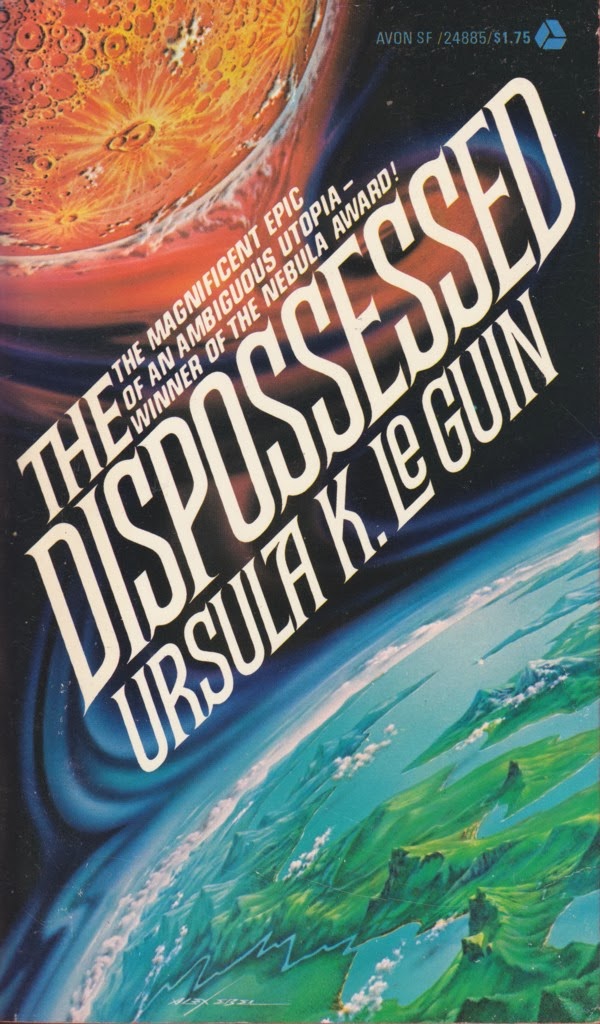
This was not what I had intended to blog about. I was going to follow up with The Dispossessed by Ursula Le Guin. But this is another heavy novel, full of feminism and socialism and human rights, and I am too tired to lift it, so I guess you're too tired to read it. If you're still there. You might be reading through the troves of articles about Anonymous - now there's a real life story designed to extract the idealist in you. (Ask Kanye to sort it out.)

I do like the list of things I like above. I enjoy novels that pick me up out of my comfort zone so that I can view the world around me, without feeling like none of this chaos can be contained or sanitised. These novels outline my own ideals, so that I can scratch up the edges in the real world. So I guess I have tricked myself and returned to the original tired premise. It's tired in part because of the labels we have stuck on it. Science fiction is more than a Spock costume. That is the type of fiction I like.

Monday, January 20, 2014

The Story of General Dann and Mara's Daughter, Griot and the Snow Dog: Part 1 of 1

I promised. I offered up a handful of things I don't really want. Including My Point. My Point is like the law prohibiting jay-walking: it is a good idea but who really abides by it? Apparently there's a municipality nearby that is concerned about drunken people running across the highway. There are bridges, but I mean really, don't we all think we are invincible as squint at our shoes and concentrate on slowing the world around us down? We can't even sound out jay-walking then.

Granted I am still squinting at my shoes willing them to move while the rest of y'll impersonate Usain Bolt. Which still means you only have a one in four chance of making it.

However, now I am living up my to promise, which means I get to keep him. My Point. And all the rest of the things I don't really want. You can keep them if you want? I will hold on to the permanent marker though. When I am next incapacitated, maybe I can ink the world down. You gave that up too easily. What's your game? Or do you not care? Oh, you already have one? Both a point and a marker? A guinea pig?

My promise was to keep you updated about my reading of The Story of General Dann and Mara's Daughter, Griot and the Snow Dog. (It's not exactly Reuter's story of the day, but I have promised you many other things, and none of them were any more enthralling.) I finished the book this morning. Approximately morning. Midday.

It is shorter than Mara and Dann, despite the lengthy title (try saying it as you're drawing wings on your shoes; question: if you are flying in the direction that the world is spinning, will it appear to stay still?) and its subject. The novel is concerned with history and the discipline of History. Rather, the protagonist is concerned - agitated - and incapacitated by the idea that records of the past have been lost.

In the prequel, Mara was the one concerned with the past. Now Dann has left her at 'the Farm' with her husband and is following the fractal perimetre of the coast as if he is looking for something he hasn't left behind. Maybe the search itself, the agitation, attaches to this concern of his sister's; maybe it is the proximity to the ice mountains that are 'Yerrup'.

I understand the anxiety: of not being able to hold... well, the world in my head. Of not recording every moment, as if the importance of the moment is in its living longer. Of not understanding why an ancestor has made something or done something. Of needing to understand because knowledge is an anchor - a resurrection of truth. Unlike Dann, I recognise that you can't create if you concern yourself with keeping the past alive. If you can't create, you weaken. If you can, you go to war over what is left.

Luckily we have Google so we can just sit back and let them run things. This reminds me of a book I once read, of a dystopia created by well-meaning politicians. Granted, I trust techies more than politicians.

Not to be flip, but being flip, Dann steals something else from his sister: crying at the drop of a hat. Or the shedding of dog hair. At first, these fits seem like a strength, of being able to recognise his traumas. But, as one character puts it, every refugee in the streams of refugees has suffered, but they route when given common cause and safety. Dann... needs a bib. Ok, that was flip. I am reluctant to replace this Dann with the Dann of the first book, however selfish and arrogant.

I can't decide whether the two books are similar or different. Is anything substantially new introduced? Does the second develop or resolve the themes of the first? Are the landscapes indicators of change or is the plot consistent despite their variations? Are the characters consistent or are the differences part of something else - the development of the themes, plots, pacing - or am I reading too much into what is just an happenstance of writing a sequel?

Mara and Dann is a few hundred pages short of an epic, but that's it. The siblings travel Ifrika, becoming exiles, refugees, soldiers, servants and royalty. Mara learns and analyses, inculcating her brother in her theories. Dann's knowledge (which he shares with Mara, more usefully) is that of survival. No matter how despondent the characters are, the reader always has the sense that knowledge is around the corner. Because this is an epic and this is how epics end. If seen on a movie screen.

 The Story of General Dann and Mara's Daughter, Griot and the Snow Dog feels like an exposition of just one scene from the prequel, even though it takes place mainly in two settings and only one of the main characters is the same. It is Mara and Dann concentrated but also expanded. Like orange juice, if the concentrated stuff were half as good. Dann still doesn't have the same power of analysis as his sister and sometimes seems to give up his knowledge of survival, but he has a new power over people.

And there is part of the answer to our conundrum. (Remember the one about history and recording the present while living it. Remember?) ('Part of' because first prize would be actually having all the records that were destroyed, but that's a bit like drawing wings on your shoes and expecting the world to stop.)

Why are you still staring at me like that? I'm not SparkNotes; that's as far as I walk with you. Or run. That highway there? Ok, you first. I need to squint at my shoes.

Saturday, January 18, 2014

Parts 2 & 3: Reading Mara and Dann

Dear Reader, I cheated you. This spiderweb's thread of trust that twangs between us? I danced on it. Stomp-style, not Swan Lake. Oh, that's called taking the high ground by jumping up and down on a thread in the middle of a sandstorm? Ok, then that's how I cheated you.

It's a metaphor.

No, I can't really dance on a spiderweb thread.

See, we have an arrangement between us: I post and you read. Sometimes I post and you read a year later because it popped up in a web search and you thought, lookee, another angsty literature major/writer/editor/publisher/nihilist who has taken the option of publishing her opinions without being peer reviewed.

If you could read before I could post, would we be using quantum computers? Or would you be like Kevin Spacey in that movie called Sum'in' Sum'in'? Or Bruce Willis in 12 Monkeys?

The pet guinea pig called My Point has nudged us home. While reading Mara and Dann, I wrote multiple posts. In my head. Yes, on the inside of my skull in smelly permanent market. Despite this, I can't recall a single one. Not so permanent, or so permanent they have sunk into the fleshy folds of my brain.

I finished Dann and Mara at least a week ago. Since then I have been restless. What now? The conclusion is double-edged: will we leave the characters in stasis or do we choose to hear a matching restlessness in the tone of Dann's voice? Also, what do I read next? I could choose Year of the Flood by Margaret Atwood, but I don't want to pollute either with proximity to the other.

I paced along my bookshelf, read a set of satirical essays, paced some more, eyed Ulysses again (now that would exorcise Lessing's dusty, starving refugees from my brain) and, without looking directly at it, pulled The Story of General Dann and Mara's Daughter, Griot and the Snow Dog ('General Dann' at least five times the rest of the type).

As I crawled into bed (lots of pillows to arrange in just the right geometric puzzle, y'know), I thought perhaps I had picked up the wrong one - the spines of a couple of other books look the same: dusted, with one or two purposeful figures, long titles. I was relieved. I would read whatever else it was because it wanted me to. (Self-justification is a wonderland of talking creatures and bullying objects. It's where the tooth fairy comes from.)

You know what happened, because you too come from this magical land. Or you are versed in the conventions of different types of text in different media. Or you just know I like to string you along, while really wanting to tell you my point. (Even reading is its own story.)

The average-sized, average-weight paperback with the sandblasted spine was The Story of General Dann and Mara's Daughter, Griot and the Snow Dog. (While the cover of Mara and Dann is a classic Vintage design, with bars of gold and black, and one simple dominating image. The card stock is lighter, I think, but feels luxurious. The paper too: thinner but silky. A reader knows this is Literature of Some Weight (excuse the pun)).

Now, I was in my own sandstorm (you can replace 'sand' with an appropriate word), partly of my own making. But, and tell me if I'm alone here (knock once on your computer screen for 'yes'), deep in the recesses of my brain, next to the other posts I 'wrote', I believe everything is my fault. War, poverty, spilt ice cream. So, in my mind (but not in reality, because the upper echelons of my brain are rational), it is up to me to fix everything. Because clearly I am the only grown-up in sight. (That's 10-year-old me talking.)

At first the book was a paperweight I used to exercise my fingers and thumb. (A Kindle switches off after five minutes, which is an annoying reminder you aren't reading. Amazon can do many things, but not fix that.) Then I started to read because no one puts me in a corner, and gorged on images of war, poverty... and a puppy.

In Mara and Dann, the relationship between brother and sister is a powerful counter to the sandstorms of war and poverty around them. For me, it is the most important theme (but not the only - that would be dull) in the novel. This is up for some interesting debate, when you finish the book. The snow dog is that for me in the second novel (so far. If anything happens to that dog, I will find a portal of crazy into that world and maim the person who did it. And I don't have much (real...) experience in maiming, so it could get ugly).

Ms Doris Lessing's experiments in dystopian (is it postapocalyptic if you don't know what happened and whether everyone really did die and aren't holed up somewhere in Asia? And when an entire continent survived...?) landscape are dark but solidly knitted together. They accept the stupidities of human nature but offer some hope in the individual who is tried and found... to be a survivor. (This is a flash-summary (except, like, expanded) of what the posts stinking up my inner brain would have looked like.)

These books remind me that the world is, war and poverty aside, mostly a sandstorm (for many of us, at least). But that the world is also something to explore. If you are curious, you will experience many things, not always pleasant, but the trick is to maintain your distance, be an individual and be curious.

More to come. No, really this time. I vow on the twanging spiderweb thread. And my pillows and permanent marker. Ok and the guinea pig.

Friday, January 3, 2014

Part I: Reading Mara and Dann

Last visit I told you about Doris Lessing and my profound encounter with her early feminist novel, The Golden Notebook. I also confided about my guilt - it's not confidential any more, is it - nothing's confidential on the internet - unless you're an NSA hacker who can hack into iPhones. Then I guess you know how to keep the lesser (Google) hackers out. Nah, Google'd just use a hybridised Gmaps to find it. And so begin the Cyber Wars. Bring it. Just wait for me to find a techie minion with something to prove.

I have a foolproof (and I mean 'fool') strategy: Say nothing, write nothing, but hear and see everything. The middle one being problematic. Do as I say, not as I do, friend!

I was fretting about how to tie my conspiracy rant (is it a conspiracy if it's true? Let's ask Wikileaks) and the sidelined subject of this post: Mara and Dann. Then I told you what to do (like in an autocrat and that's exactly what this - my blog is an autocracy, paeon - friend) and if I had an advisor (where do I get one? For free?) she would have said, "the What Did You See game! In that game, say what you can afford to, write nothing, see and hear everything."

Mara and Dann is set on a continent named Ifrika (ingenious, that) in an unspecified and difficult to decipher time. The sister and brother are born and grow up in the middle of southern 'Ifrika'. A drought is spreading from the south out, pushing columns of refugees north before it. In these columns, the only prejudice is against people who have more than others: water or food. And there is often little to stop the stronger taking what they want from the weaker.

The size of the animals is bizarrely exaggerated: water dragons and stingers about the size of dogs lurk in and around water holes, picking off the weakening animals - and people. The former is usually found on Darwin's islands and the latter is a mutant scorpion.

These scenes, in pencil on tracing paper, are laid over the southern Africa in which I live and have travelled through. I know this feeling because often I feel like a foreigner in my streets, cities, country, region and continent. I suspect this is intentional (although who can ever pin down the intentions of an author - Future Author Me plans to contradict everything anyone says - it's boring to repeat "The answer is in however you see it." Yes, well, you're not dead and the book exists in black and white, not as a hologram, so say something, dammit!) to mimic the characters' confusion and sense of displacement.

But I (the reader) have my own reservations (always!) about viewing the foreign, too. About pasting (not glue, obviously, but ctrl + v) pictures of the smiling and obsequious people you meet next to photos of oblivious animals. (Oblivious unless you smell like a fleshy meal or have a gun in one hand.) When you meet someone foreign to yourself, you catalogue their differences, right? And, be honest here, you perceive these differences as wrong or inexplicable, friend. Even ridiculous.

In Mara and Dann, these differences are mostly threatening - remember: food and water, pursuit by mutant animals, racial difference. Is this not how war curdles, whether offensive or defensive? (Ok, usually not with mutant animals.) (War, a truly ridiculous custom.) This war is not addressed in the first half of the book, but it is there traced over people's interactions, particularly in Mara's answers to the What Did You See game. (This is not your monotonous I Spy - this is how 'Mahondi' children are taught to reason.) She senses destruction, knowledge and cunning, where others see a kopje or prison.

Although, as a reader primed to read the signs, all this and more seems obvious.

Knowing what we do about the psychology of the strong confronted by the weakened (and the nature of stories), that the North is a pipedream or unreachable seems obvious. But then, I don't like (nor do I believe in, but that's another story) happy endings. So I'm betting on the sure thing: war. (FYI I think war is ridiculous, but I would also like to see a return on my money. You know, if you're interested, I know someone ...) But I think Mara already knows. I think that because of what she did see, she knows what she will see.

PS. I am halfway through the book. There is so much more to say, so I am concentrating on the political issues, as a base in her oeuvre. Also, because I want to and I am autocrat here. Though I am still thinking of a fitting designation: Queen - too haughty; Tsar - too haunted; Prime Minister - so boring ...